
Process
Shed slab thickness and prep for Perth backyards
What a shed slab actually needs in Perth: thickness, mesh, base prep and dealing with sandy soils, explained simply.
Putting up a shed seems simple until you get to the slab, and then the questions start. How thick does it need to be? Does it need mesh? What happens with Perth’s sandy soils? Getting the base right matters more than almost anything else about the shed, because a shed is only as good as the pad it sits on. Here is what a shed slab actually needs.
Thickness: it depends on what is going on it
For a typical residential shed used for storage, tools, a ride-on mower and general backyard use, 85mm to 100mm is the standard thickness range. This handles normal foot traffic, shelving loads and everyday shed contents without issue.
If the shed is going to carry heavier loads, things change:
- A shed doubling as a workshop with a vehicle hoist, welding equipment or heavy machinery needs a thicker slab and often additional reinforcement to handle point loads and vibration.
- A shed intended to store a car, trailer, boat or caravan needs to be treated closer to a driveway or garage slab than a basic storage shed, both in thickness and reinforcement.
- Larger sheds spanning a bigger footprint may need thickening at load-bearing wall lines, even if the rest of the slab sits at standard thickness.
The right answer depends on the shed size, what is going in it, and the manufacturer’s footing requirements if it is a kit shed, since most shed suppliers specify a slab standard the base needs to meet for their warranty to hold.
Mesh and reinforcement
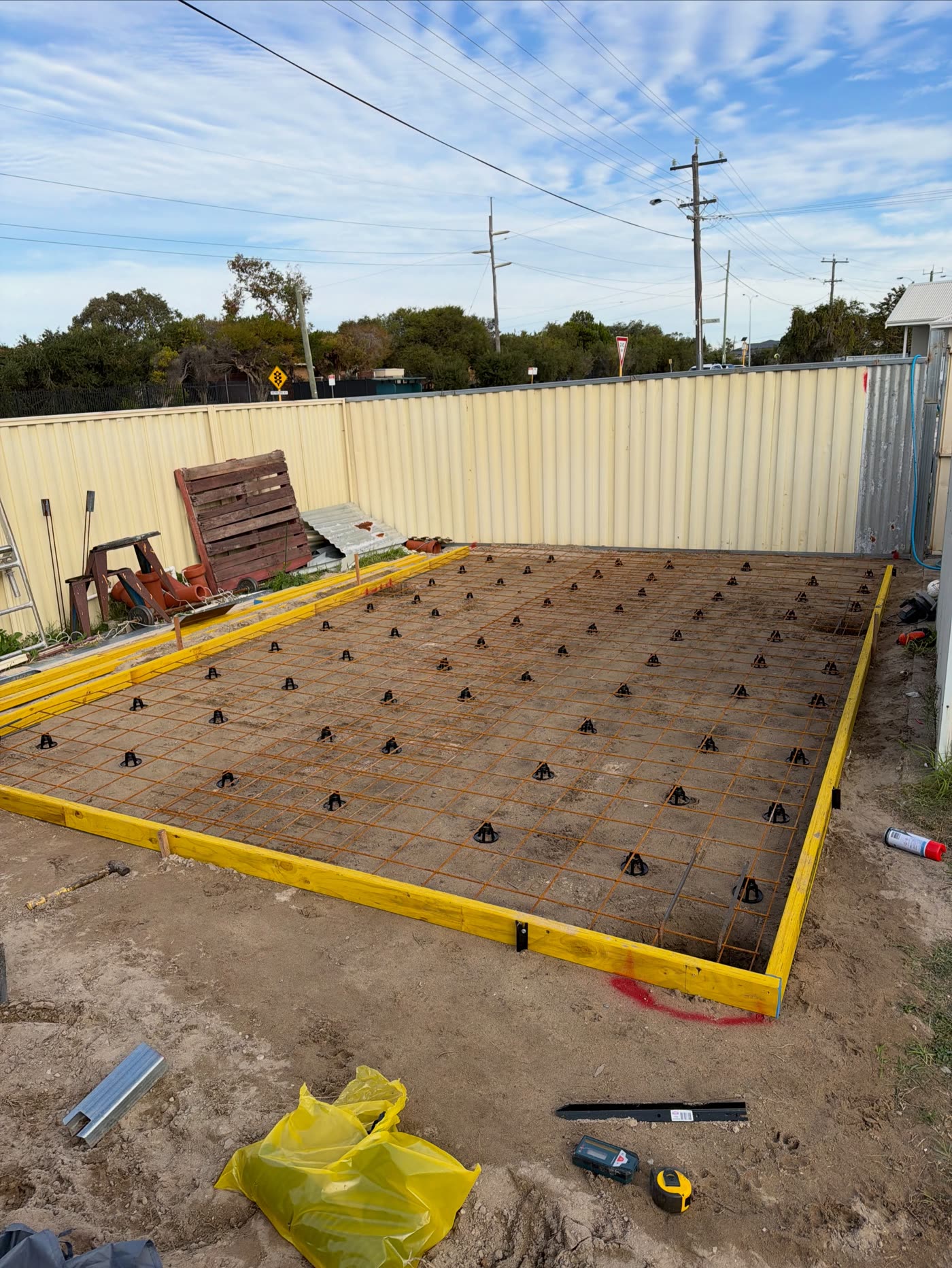
Steel mesh reinforcement is standard in a shed slab, tying the concrete together so it resists cracking under load and movement. For most residential shed pads, a standard mesh sits within the slab at the correct cover depth, positioned before the pour rather than dropped in after.
Reinforcement requirements step up with slab size, thickness and expected load, which is part of why a proper measure and quote matters more than guessing off a generic spec sheet from a shed kit box.
The base underneath matters as much as the concrete on top
A slab is only as good as what is compacted underneath it. In Perth, that usually means dealing with sandy soils, which have their own quirks.
Compacted sand pad. Perth’s sandy ground generally compacts well once properly prepared, but it needs to be done correctly. That means excavating any loose, organic or previously disturbed soil, then building up and compacting a clean sand base in layers to the correct level and density before concrete goes anywhere near it. Skipping proper compaction is one of the most common reasons a slab settles unevenly or cracks later.
Level and drainage. The pad needs to be built to the right level relative to the shed’s footprint and to shed water away from the structure, not pool against it. This matters even in a low-rainfall climate like Perth, because the wet season still needs somewhere for water to go.
Formwork. Timber formwork sets the exact dimensions and level of the slab before the pour, and needs to be square and properly braced so the finished slab matches the shed manufacturer’s footprint precisely. A slab that is out of square or the wrong size causes headaches when the shed kit goes up.
Apron and approach considerations
Many shed slabs benefit from a small concrete apron extending beyond the shed door, giving a clean, level surface to wheel equipment, a mower or storage items in and out without stepping onto grass, gravel or bare sand. This is worth planning at the same time as the main pad rather than adding later, since it can be poured as one continuous slab with the main pad, avoiding a visible joint or level mismatch at the doorway.
If the shed will be accessed regularly by vehicle, such as driving a ride-on mower or small trailer in and out, the approach path leading to the shed door also needs to handle that load, not just the pad itself.
Common mistakes we see
Pouring straight onto unprepared ground. Sand that has not been properly compacted will settle over time, taking the slab with it unevenly.
Undersizing the slab. Building the pad to the shed’s exact footprint with no allowance for door swing, eaves or a small apron in front of the shed door often means redoing the concrete later when it turns out slightly too small.
Ignoring fall and drainage. A slab poured dead flat with no fall can pool water at the shed door or against the shed wall, which is avoidable with correct planning before the pour.
Wrong thickness for the load. A slab poured to bare minimum thickness for basic storage, then later used for a car or heavy equipment, is set up to fail. It is worth telling your concreter exactly what the shed will be used for, including future plans, before the pour.
Planning the slab around the shed kit
Most shed kits, whether a simple garden shed or a larger workshop-style structure, come with manufacturer specifications for the base they need to sit on. This usually includes minimum slab dimensions, anchor point locations for the shed frame, and sometimes a minimum concrete strength or thickness requirement to keep the warranty valid.
It is worth getting these specifications before the slab is poured rather than after, since retrofitting anchor points or adjusting a slab that is the wrong size once the concrete has cured is far more difficult and costly than building it correctly from the plans the first time. If you have already bought a shed kit, bring the manufacturer’s base requirements along to your measure and quote so the pad is built to match exactly.
Timing your shed slab around the build
Shed slabs are often one of the more time-sensitive concrete jobs, particularly if a shed kit has already been ordered and delivery is booked. Concrete needs adequate time to cure before the shed frame can be anchored and the structure erected, so it is worth booking the pour with enough lead time before the shed arrives rather than trying to compress the schedule. Talk to us about your delivery date and we can plan the pour and curing window around it, including weekend pours if your timeline is tight.
Getting it right the first time
A shed slab is not a place to cut corners, since it is expensive and disruptive to fix once the shed is up. CJH Concrete pours shed pads across Perth’s northern suburbs including Merriwa, Kinross, Quinns Rocks, Padbury and the Joondalup belt, and metro-wide, with the base prep, thickness and reinforcement matched to what the shed will actually carry.
For a free measure and quote on your shed pad, call 0476 722 330 or reach out via contact. See examples of finished pads on the gallery page, or read more about our slabs and pads service.